


A squeaking hinge can be ignored for weeks, but the moment a door starts catching its frame, the problem stops being cosmetic. A door that sags, sticks, or strains at the screws is telling you that the hinge has reached its limit. Brass hinges handle repeated load better than standard steel, resist corrosion in humid rooms, and keep a smooth pivot for years. This guide explains what actually matters when you choose a brass hinge, how to size it, and what quality differences are worth paying for.
Why Brass Hinges Outperform Other Door Hinge Materials
Brass is an alloy of copper and zinc. The exact ratio changes the hardness and color, but most door hinges use roughly 60% copper and 40% zinc. The zinc contributes strength, while the copper brings corrosion resistance. That combination matters in a door: every time you open and close it, the hinge pin rotates against the knuckle, and any oxidation on that contact surface adds friction. Brass oxidizes slowly, and the oxide film is relatively soft, so the hinge continues to move easily as the metal wears.
Brass vs. Steel vs. Iron
Steel hinges are stronger by volume, which is why heavy commercial doors often use stainless steel. But steel rusts unless protected. Powder-coated or zinc-plated steel hinges lose that protection wherever the coating is scratched during installation, and a scratch on the edge of the leaf will rust over time. Iron, common in older residential construction, is even more corrosion-prone. Brass, by comparison, is a better match for interior doors where humidity fluctuates from season to season.
| Material | Corrosion Resistance | Load Capacity | Typical Use |
|---|---|---|---|
| Solid brass | High | Medium-High | Interior doors, decorative applications |
| Stainless steel | Very High | High | Wet areas, exterior doors |
| Powder-coated steel | Medium | High | Heavy doors, painted frames |
| Iron | Low | Medium | Traditional, rustic doors |
There is one distinction worth spelling out: solid brass versus brass-plated steel. A plated hinge can look identical in packaging, but the screw threads and the bearing surfaces are steel. Once the plating wears, the steel rusts and the hinge binds. For a door that weighs 40kg or more, solid brass is the safer choice.
Brass Hinge Types for Interior Doors
Most interior doors use butt hinges. The two leaves are mortised into the door edge and the frame, and the pin connects them through a cylindrical knuckle. Within the butt hinge family, three variants cover nearly every residential application.
- Plain bearing - simplest construction, suitable for 20-30kg doors
- Ball bearing - steel or brass balls reduce friction under load, suited for heavy WPC doors
- Spring - self-closes, used for fire-rated or smoke-control doors
The bearing type changes the feel of the door. A plain bearing hinge on a 35kg door requires the user to overcome more friction. A ball-bearing hinge does not make the door lighter, but the pivot is smoother, especially on a door you open every day.
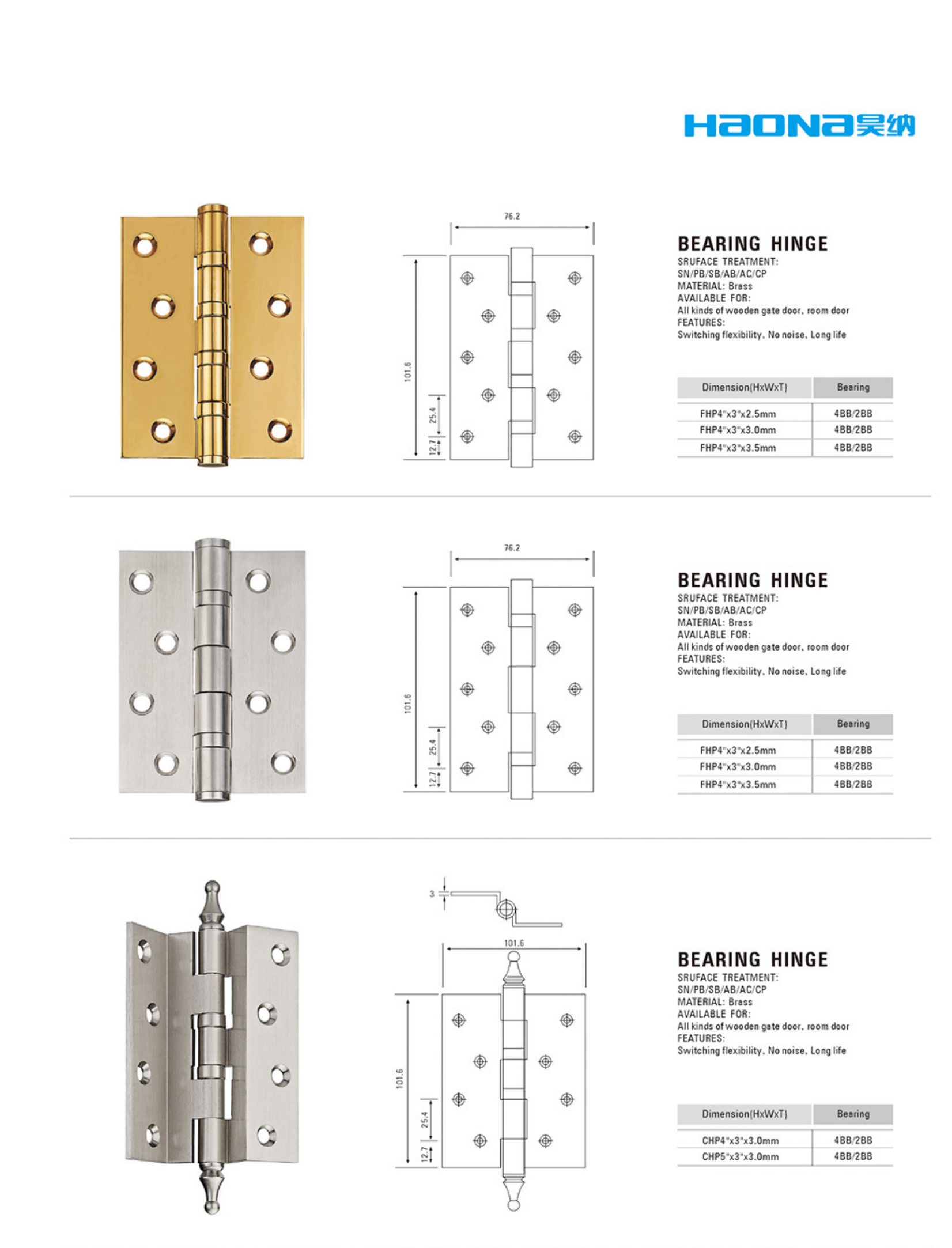 Heavy Duty Brass Hinges for Solid Wooden Gates and Exterior Doors These thick-gauge brass hinges offer corrosion resistance and even weight distribution, making them a stable pivot for heavy timber doors. Ideal for outdoor use, they combine classic style with durable construction. View Product →
 Key Brass Hinge Specifications to Check Before Buying
Three numbers define whether a hinge will work for a specific door: hinge width, hinge height, and leaf thickness. Hinge width is measured from the frame leaf to the door leaf when the door is closed. Hinge height controls the screw spacing and the support area. Leaf thickness, often around 2.0mm to 3.0mm on solid brass hinges, is the most direct indicator of strength. A 2.0mm leaf on a 40kg door is acceptable; a 1.5mm leaf is not.
The tolerance between the pin and the knuckle also matters. A well-made hinge has a close fit that prevents wobble. If you hold the hinge open and move the leaves vertically, you should barely feel any play. Play in the knuckle means the hinge will gradually allow the door to drop.
| Door Thickness | Conventional Hinge Size | Load Range per Pair |
|---|---|---|
| 35-40mm | 75mm x 55mm | 20-35kg |
| 40-45mm | 100mm x 75mm | 35-50kg |
| 45-60mm | 125mm x 80mm | 50-80kg |
These ranges are for standard interior doors with two hinges. A 2.1m WPC door slab usually needs three hinges. Adding one hinge in the middle is cheaper than replacing a sagging door.
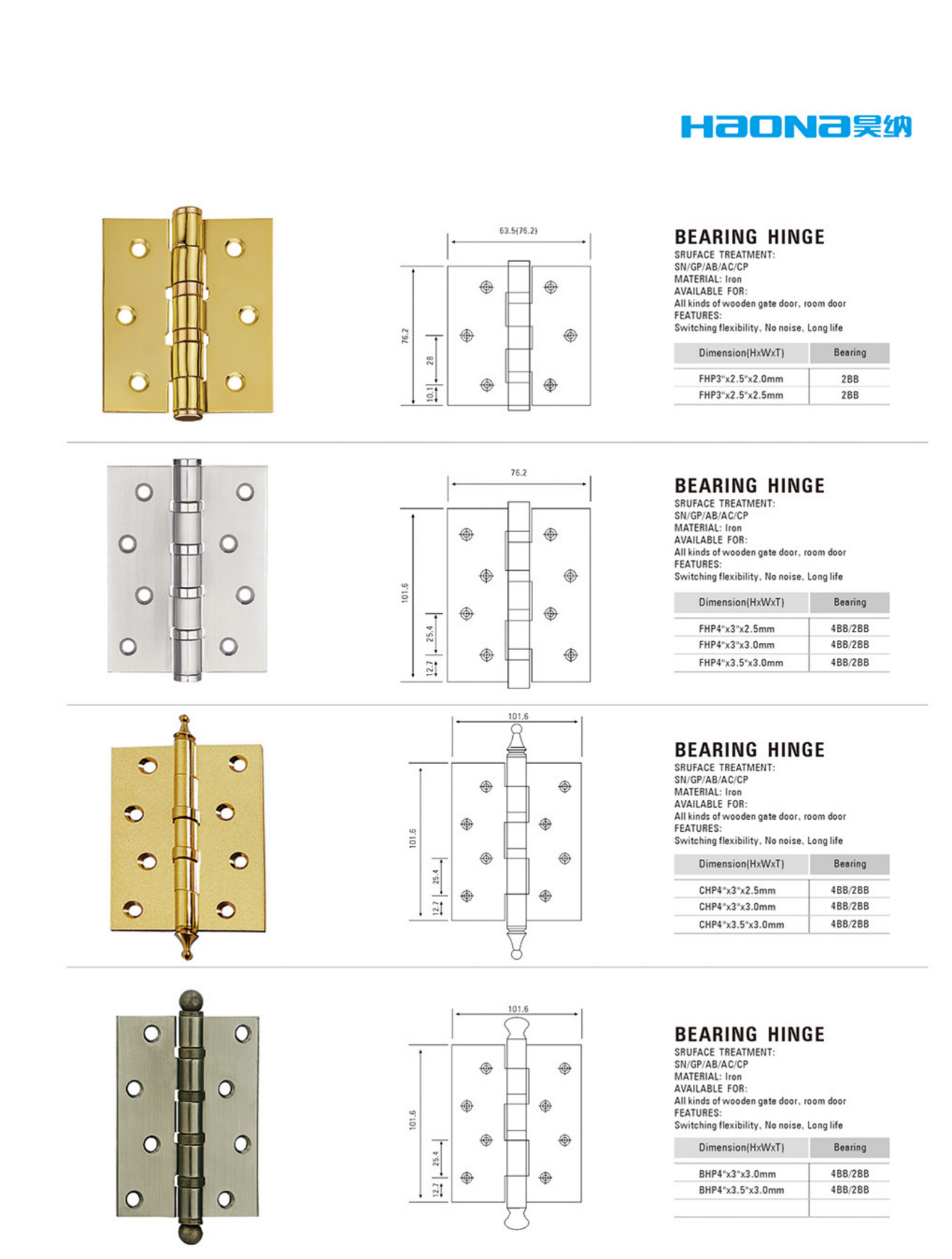 No Noise Iron Hinges for Quiet Cabinet Operation Featuring nylon bushings or ball bearings, these iron hinges eliminate squeaking and are suited for high-frequency use in kitchens and bedrooms. The anti-rust coating ensures lasting performance. View Product →
 Matching Brass Hinges to WPC Doors
WPC doors do not behave exactly like solid timber. The core is a wood-plastic composite, which means the screw holding power is consistent but different from softwood or hardwood. The edge material of a WPC door tends to be denser than MDF, but a screw that is too close to the edge can still blow out the laminate.
So when you fit a brass hinge to a WPC door, consider the screw hole spacing and the distance from the screw to the edge of the door. A hinge with staggered screw holes distributes load better than a hinge with all holes on one line. On a 40-45mm thick WPC slab, use at least three hinges spaced roughly 300mm from the top and bottom.
Sourcing hinges from the same manufacturer as the door panel is convenient for another reason: the hinge recess depth and the screw length are often specified to match the panel edge. When you buy doors and hardware separately, the door builder and the hinge supplier each make assumptions about the other's geometry, and you absorb the difference on site.
Installation Tips for Brass Door Hinges
Installation is where most hinge failures start. A perfect hinge can perform badly if the mortise is sloppy or if the screws are forced.
- Mark positions on the door and frame; use a square to transfer the lines.
- Rout the mortise at 5-6mm depth, checking with the leaf thickness.
- Drill pilot holes slightly smaller than the screw shank; brass screws are brittle.
- Fit the door leaf first, then shim the frame side.
- Align the gap and check the swing before driving the frame screws.
- Drive all screws by hand rather than with a drill when the screw starts to bite.
One common mistake is using screws that are longer than the door thickness allows. In a 40mm WPC door, a 25-30mm screw is typically enough. A 50mm screw will pierce through the panel core or the decorative film.
Maintaining Brass Hinges for Long-Term Performance
Brass tarnishes over time, but tarnishing does not damage the hinge. The patina is actually the metal reacting with oxygen and forming a protective layer. A soft cloth and brass polish will restore the shine, but on an interior door, many people leave the patina and treat it as a design choice.
The mechanical issue is lubrication. A dry knuckle gap makes the door squeal. Apply a light PTFE or lithium grease to the knuckle and work the door open and closed a few times. Avoid penetrating oil or WD-40; those flush out existing lubricant and leave a residue that collects dust.
For doors in bathrooms or kitchens, inspect screws annually. Expansion and contraction in humid air can loosen the frame screws. Tightening them with a screwdriver, not a drill, prevents stripping the brass threads.
Final Considerations When Buying Brass Hinges
Budget hinges tempt buyers because the installed difference is not visible until the door starts to misbehave. The total cost of replacing a hinge after paint and floor finishes are in place is far higher than spending a few dollars more at the start. Compare three things before you buy: leaf thickness, bearing type, and whether the hinge is solid brass or plated.
Ask for the hinge dimensions in millimetres, not just the inch description. A 3-inch hinge from one supplier may have a different leaf shape and screw pattern than a 3-inch hinge from another. If you are replacing a hinge on an existing door, the screw hole positions and the mortise depth matter more than the nominal size.
For new construction, it helps to buy from a single source. Door manufacturers that also produce their own hinges are able to test the hinge against the actual door slab, not just against a catalogue description.
Choosing the right hinge for a wooden gate door follows the same principles, but with different load requirements. If you are working with a gate or a heavier outdoor door, the hinge type and material need to line up with the weight and the exposure to weather.
Contact our team if you need help matching WPC door panels with brass hinges for your project.


